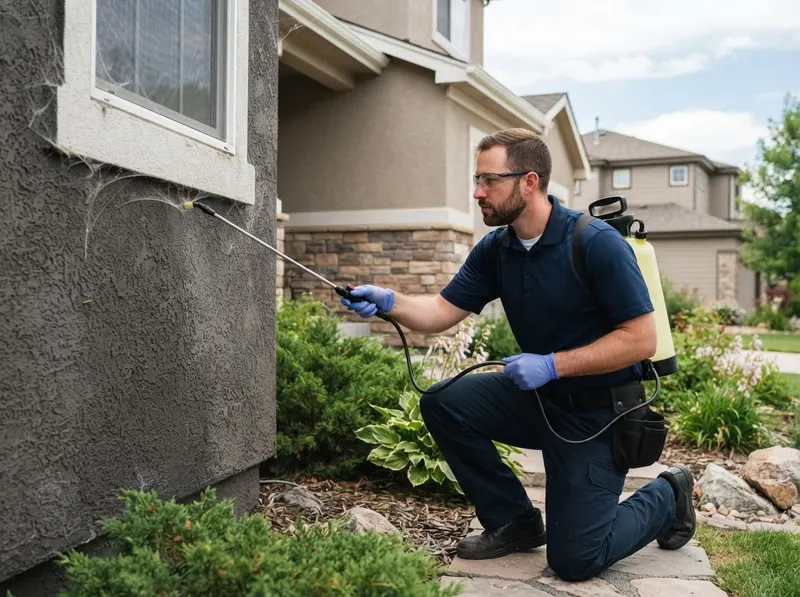
Nuisance spider reduction addresses structural infestations common across the City and County of Broomfield, where proximity to native open spaces creates persistent arachnid pressure. Properties along Josh's Pond Trail and open drainage channels in McKay Landing encounter seasonal surges of funnel weavers (Agelenopsis spp.) and western black widows (Latrodectus hesperus) migrating from prairie turf into foundation cracks. In newer subdivisions like Anthem Colorado, unsettled topsoil and automated irrigation drive ground-dwelling wolf spiders (Lycosidae) toward cool crawl spaces, slab perimeters, and basement egress windows. In contrast, older bi-level builds near Lac Amora and Westlake frequently house high volumes of yellow sac spiders (Cheiracanthium inclusum) in ceiling corners and upper window casings, which often go unnoticed until late autumn temperature drops push them indoors.
Decision guidance relies on distinguishing spider control from general pest spraying: broad-spectrum exterior treatments often fail on spiders because arachnids stand high on long legs, reducing cuticle contact with flat ground residues. Effective reduction pairs physical de-webbing using an electrostatic pole up to 20 feet high with microencapsulated pyrethroid perimeter bands across foundation stems. If web accumulation is heavy on north-facing eaves or near patio lighting, a targeted dual-action contact spray knocks down adults while micro-granules protect mulched landscape beds. If an unfinished basement contains heavy webbing, targeted crack-and-crevice spot dusting in sill plates delivers superior long-term results compared to whole-room fogging, which fails to reach spiders tucked behind wall insulation.
Treatment limitations apply during adverse local conditions. High wind gusts off the foothills along the Interlocken corridor or sudden Front Range afternoon rainstorms require re-scheduling liquid exterior applications to ensure active ingredient adhesion to stone veneer and concrete. A common misunderstanding is assuming one application produces permanent prevention: spiders lack grooming behaviors common in insects, meaning they must cross treated zones or eat contaminated prey. Residual barriers break down within 60 to 90 days under direct UV exposure, making quarterly barrier applications necessary to prevent re-infestation. To schedule an inspection or arrange service, call (970) 602-3471.